
The Temple of Horus




Isis, Osiris, Horus and the Greeks
21 November 2006
A sunny Tuesday morning found us docked at the quay side in the town of Edfu which is famous for its Greek/Egyptian Temple dedicated to Horus.
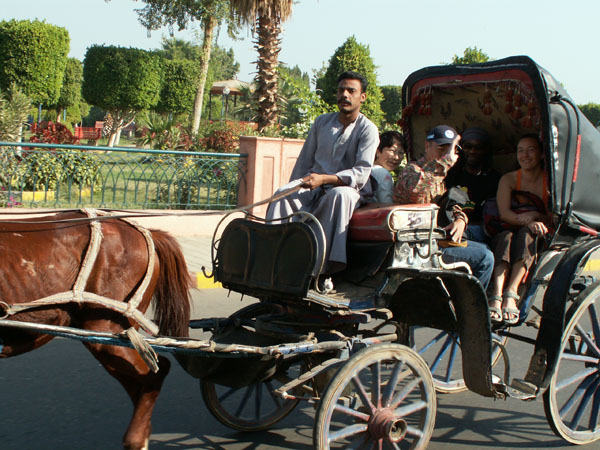
Our guide Mina informed us that in years gone by the only way to get to the temple was by horse drawn calèche and my memory seems to recall that being the case in 1990. Now however you can go by vehicle as they have put up a taxi rank at the site. Actually it is more a horse stable than anything else, with each cabby having his alloted shaded stall.
We had a choice Mina declared, horse or bus ? By horse we all cried. Oh great mumbled Mina. In Edfu the coachmen will agree a price and look for yet more baksheesh. Mina told us to be strong willed and refuse, he would argue with the coachmen for us.
Our calèches arrived, we noted our number (JJ and I were in number 93) and off we trotted. Then we cantered and then we galloped, each coachman trying to get to the site before the others, weeving in and out of the traffic and pedestrians. Ben Hur would have been left at the starting blocks.
I had the feeling they were all trying to get to the site before Mina but any hassle that was suffered was actually on the return.
JJ and a couple of others in the group were accosted by the bazaar merchants on the way out of the temple. In some cases they would actually grab people by the arm and try and pull them in. Jean-Jacques was polite but firm.
According to one version of the mythology:
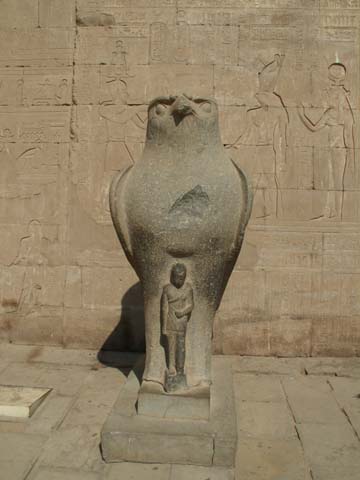
One of the granite statues of Horus
Once upon a time there were four children. Two brothers; Osiris and Set and their two sisters Isis and Nepthys. Osiris and his wife/sister ruled over Egypt and whilst Nepthys was in theory betrothed to Set she also had hankerings for Osiris which left Set rather jealous.
Set created a wonderfully ornate chest and threw a great party during which he offered to give this fantastic creation to anybody who fitted the interior exactly. By sheer coincidence Osiris just happened to be the exact size and as soon as he was in it, Set had the chest nailed shut and thrown in the river.
Later, to be sure to be sure, he recovered the box and had Osiris chopped into 13 pieces and scattered far and wide over the kingdom.
Isis searched far and wide and recovered all of the parts save one, which had been eaten by a fish (it probably tasted like chicken - sort of). Using mud from the Nile Isis recreated the missing organ and called upon the god Anubis to breath life into Osiris for just one more night. During the night she bade farewell to her husband and fell pregnant - good stuff this Nile clay.
The result of the pregnancy was Horus (one of the falcon headed gods). Isis hid Horus in the papyrus plants to keep him from the prying eyes of Set and thus Horus survived to adulthood.
In the temple at Edfu there are depictions of Horus aided by Ptolemy the Umpteenth in his great battle against Set. Horus is of course a big guy and Set is reduced to a tiny hippo. At the end of the battle Set is judged by the other gods to be the bad guy and banished forever.
During the battle though Horus lost one of his eyes and the symbol of the eye of Horus became connected with the idea of protection.
The temple is in fact a Greek construction - built (237-57 BC) by the Ptolemies of Alexander the Great. Why ? You may well ask. In fact as a political move by the Greeks.
The Egyptians had considered the invading Alexander as a liberator from the yoke of other occupying nations and when Alexander went on to consult the oracle of Amun he discovered much to everybody's amazement that he happened to be the son of the king of the gods (Amun = Zeus). Being the son of god definitely lent legitimacy in the eyes of the Egyptians to his claim to be Pharaoh.
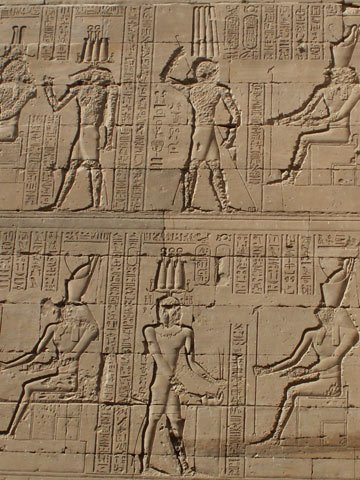
Note the blank cartouche by the second figure in the bottom line
The next trick up his sleeve was to build new temples on important sites already related to the Egyptian gods and in this way the Ptolemy family ruled happily over Egypt until Cleopatra VII went down with a bad hair day.
The Egyptians were content with overlords who were not Syrian or Nubian and more to the point venerated their own gods.
The Temple is the best conserved from this period of Egyptian history and is a fine example of a Greek copy of an Egyptian temple.
The temple had been half submerged under the sand and around the outer walls the town of Edfu stands some 15 or 20 metres higher than the temple floor.
The first pylon is an impressive 36 metres high and shows the all but obligatory picture of the Pharaoh knocking the ten bells out of various enemies in honour of Horus.
A winged sun disc with cobras either side was considered a great symbol of protection and surmounts all the great portals of the temples.
The carvings on the walls are particularly fine and in the courtyard by the entrance to the hypostyle hall stands a granite effigy of Horus.
Mina pointed out to us that some of the cartouches next to the pharaoh were blank. This was because the carvers couldn't keep up with which Ptolemy was currently on the throne. This is possibly the first instance in writing of: Insert name here.
The cartouche represented the border of Egypt and the name within the ruler (Pharaoh). The gods on the other hand, ruled everywhere so their names were never enclosed.
At Edfu Jean-Jacques had the chance for the first time to fully appreciate a temple because the roof is intact. You feel that you are properly inside a building as opposed to ruins.
The inner sanctuary or naos is made of granite and contains a reproduction of the sacred boat of Horus used by the priests when transporting him about.
The naos is the oldest part of the temple and was dedicated by the Pharaoh Nectanebo II (360 - 343 BC) who was the last Egyptian to rule over the country.
Each year Hathor the wife of Horus would leave her own temple further down the Nile at Dendera and visit her husband. Her name means House of Horus and whilst his glyph is a falcon, hers is a caged falcon - Mina informed us that many Egyptian men felt like Horus.
The nilometre is visible in its well and this was used by the pharaohs to set the tax level on the priests. The higher the Nile's inundation the higher the taxes. It made sense because the greater the flood the greater the harvest.

 Page 5
See also