
In Nubian Territory


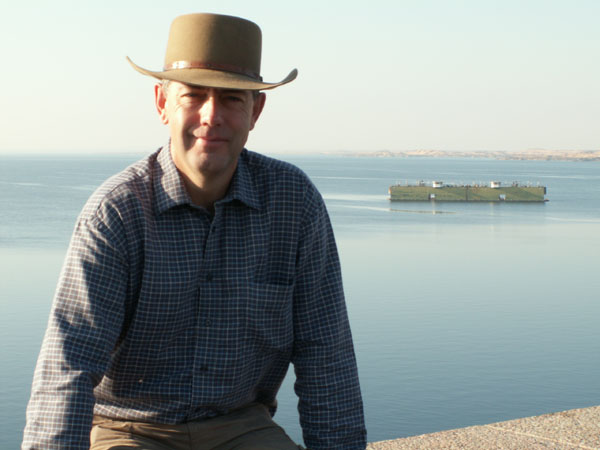


The High Dam
22 November 2006
Over night our boat had sailed into Aswan and the early breakfast had us all up and ready for a long day of adventure. Looking at the things still left on our itinerary I was starting to wonder how on earth we were going to fit it all in - but we did.
Luxor, declared Mina is a town undergoing a lot of reconstruction - they said the same 16 years ago when I first visited. Aswan he added is a far bigger city and much more pleasant - they have been saying the same for hundreds of years and the town was always popular with the British who came here for the winter sun. It did rain sometime in the nineties but that wasn't for very long and the local Nubians hardly bother with roofs for their dwellings.
The position of the town is important because it sits right on the 1st Cataract of the Nile. These great rapids are unnavigable by boat with huge boulders of granite blocking the way. It thus became a frontier post, the last inhabited place in the south of Egypt.
The town also became important because of its granite. The blocks for the pyramids near Cairo and most of the great obelisks were all quarried in Aswan and then floated down the Nile during the flood.
At the turn of the 20th Century the British commenced work on a Dam crossing the 1st Cataract between Aswan and the island of Philae. When it was finished in 1902 it was the largest in the world with a length of just over two kilometres and a height of 51 metres.
The dam helped control the Nile floods but at the same time prevented a lot of the nutrients from flowing down the river. Many farmers these days have to resort to fertilizers.
The problem with the dam was that it almost overflowed a couple of times and when President Nasser came to power in 1952 he declared that a new dam was a priority. Following a lot of wrangling and the Suez Crisis the Soviet Union stepped in with an aid package.
The new dam is called the High Dam and is impressive; 3600 metres in length, 980 metres wide at the base, 40 metres wide at the top and 111 metres tall. It is a military zone so video cameras are not allowed.
On the northern side is the hydroelectric station which provides Egypt with about 15% of all its power requirements.
To the south stretches Lake Nasser - the largest man made lake in the world with a length of 550 kilometres. Photos cannot do it justice so like everybody else we sat on the parapet and contented ourselves with what we could.
The lake however created as many problems as it solved. The major problem was the fact that it left 60 000 Nubians homeless, their dwellings submerged under the rising level of the lake. The same went for many of the ancient temples that found themselves in the way of modern Egypt's need to control its water supply.
The Nubians found themselves simply uprooted whilst international calls for aid helped save some of the temples.
One thing that Mina did say was that obviously the Nile crocodiles cannot get past the dam. Whilst looking into the water we did see what at first we thought was a fish coming up for air with the rings in the water. Then something definitely more solid came up to the surface before submerging again. It wasn't a piece of floating wood - so who knows.
As that great Australian Dame would say: Spooky !
Philae
The word Philae means remote and could be considered the ancient equivalent of outback because this was as far out into the desert as Egypt went - Alice Springs with water.
Half submerged following the construction of the British dam in front of it, the island temple of Philae was threatened with being drowned forever with the creation of the high dam behind it.
There is no doubting the beauty of the setting of this place - all the more remarkable when you realise that the temple has in fact been carved up and moved to an adjacent island which remained out of the water.
Everybody and his dog has been here including British military expeditions and the army of Napoleon, all of whom have left carvings on the walls. It was of course thanks to a French soldier that the Rosetta stone was discovered (filched by the English after they had put an end to Napoleon's Egyptian campaign.) and it was a Frenchman: Champollion who finally cracked the hieroglyphics.
The temple is another Greek/Egyptian edifice though the original vestiges belong to Egyptian rulers and the final constructions are Roman. The first pylon as always shows the Pharaoh smiting his enemies but what is immediately evident is that the carvings have been defaced.
This is thought to have been the work of the first Christians who used the temple as a church. Their coptic crosses have been carved into a number of walls and there is evidence of an altar.
Like Edfu the great halls still have their roofs and the small size of the chapels made the building a little claustrophobic with the press of the people. The place was packed with tourists from all over the globe.
Mina would greet each group with a smile and a kind word: Where are you from ? England, that's nice. Hurry along please.
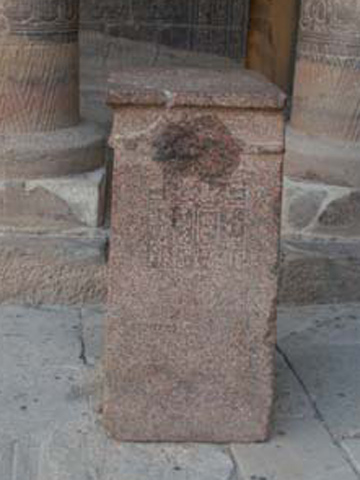
The oldest item on the island: Taharqa's altar
The top half of the walls in many places is darker than the bottom and this is due to previous visitors who came out in motor launches to visit the semi submerged temple on its original island coating the exposed walls with exhaust fumes.
The temple is dedicated to Isis (and thus by association: Aphrodite). By the time of the Arab invasion in 641 AD the temple had become a church dedicated to the Virgin Mary.
It is considered to have been the last functioning pagan temple in the west and Mina informed us that people are still known to come and dance and hold communion with the Egyptian goddess.
Before entering the temple visitors can see to the right of the ramp way a large block inscribed with the planning permission for the temple.
I am tempted to wonder how many gods sent back the reply: Sorry, but I just don't need another temple right now, besides I already have the four railway stations and the utilities.
A few metres away is an altar from the time of the Nubian pharaoh Taharqa (about 650 BC) one of the black pharaohs of the 25th dynasty. It was actually quite difficult to photograph because a young guard complete with his AK47 kept walking in front of me. He managed to smile all the time whilst doing so and was obviously looking to be paid to get out of the way. Eventually he found somebody else to guide around.
The story of Isis and Osiris and Horus was central to Egyptian culture and Mina explained the initial creation of the gods starting with Atum (JJ once again) creating Shu (air) and Tefnut (moisture). They in turn had two children: Geb (Earth) and Nut (Sky). The last two were forever looking to get together and Atum eventually decided that Shu should intervene pushing the couple apart.
Putting air between the earth and the sky however had not stopped them having four children: Isis, Osiris, Set and Nephthys.
In the evening four of us came back again for the son et lumière which tells the story of Isis upset by the that fact her temple has fallen into disuse. She explains how she found the heart of Osiris nearby and how Horus was born here. The god of the Nile: Hapi, replies that like Osiris her temple has been reborn from out of the water and that she should be pleased that thousands visit her temple everyday to marvel at her history.
The sound system is excellent and it was nice to be able to walk through the buildings without a crush of people going in all directions. The lighting really brought up the carvings on the wall making them far easier to read - Mina had been instructing us in hieroglyphics so we were starting to get quite good at recognising gods and even some pharaohs by their inscriptions.
We paid 16 Euros each for the trip which included the drive from the boat to the dock, our boat across and the entrance ticket. Needless to say our boat and taxi had to wait on us. It was well worth the money and was far more interesting than that at Karnak.
Kitcheners Island
Having put down the Mahdi's revolt in the Sudan the British general Lord Kitchener was given one of the small islands in the middle of the Nile at Aswan.
He came to the island quite frequently and started bringing trees from various parts of the world. Slowly but surely his 750 metre long island became a botanical garden. Today it is once again in the hands of the Egyptians and is as popular with the locals for a walk or quiet afternoon as it is with foreign tourists.
It was also the first place that we saw loads of cats. You see tired looking dogs everywhere trying to lie in the shade away from the sun but cats are not so frequent.
I did have fun in one of the shops trying to buy a small booklet about the gods. I had just seen one sold for 20 Egyptian pounds, so when the vendor asked for 50 pounds I told him that despite the searing heat I could still find somewhere that the sun didn't shine.
In the end he agreed to 20 pounds but then tried to swindle me out of my change. You have to be on the ball because they will give you a wad of folded notes as change and it is only on opening it that you find that those on the inside are for 50 piastres (half a pound).
We were all agreed that if the merchants could only stop trying to work one over on us all the time we would be far more ready to look and buy and it would probably be just as easy to make even more money out of us. I have travelled with English, Irish and French groups now, and everybody is of the same opinion - bartering is one thing, blatant dishonesty another..

 Page 6
See also