
The West Bank




The Queen Hatshepsut
20 November 2006
Oh joy, another early start to the day. Up at 0600 hours and ready for 0700. It may be winter and cold enough in the evenings but once the sun gets up you are looking at thirty odd degrees and on the west bank of the Nile there is little in the way of shade.
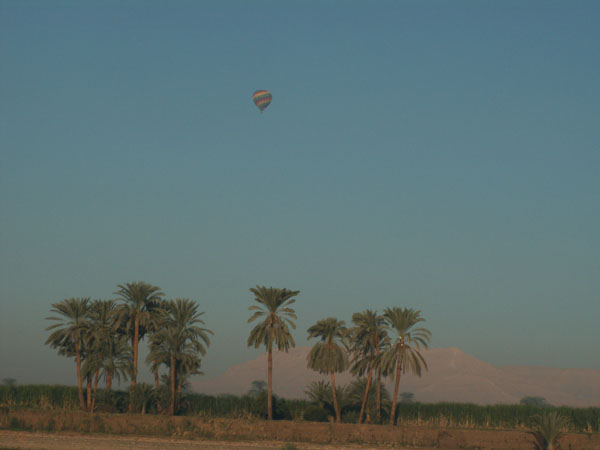
We took a motor boat across to the far side of the Nile watching the balloons drifting in from the desert and over the hill tops, the passengers dangling in the baskets must have a fabulous view over the mortuary sites and the Nile itself.
Within five to ten minutes of landing on the west bank we were standing at the entrance to the Mortuary Temple of Hatshepsut at Deir el-Bahri.
The last time I was here was sixteen years ago, and like many of the places I was going to revisit, I realised that not a lot had changed apart from the fact that there is now a proper parking area and the road is no longer rubbish. Oh and many places now have porta-cabin toilets available - very important for people like JJ !
Hatshepsut was an interesting lady who ruled over Egypt from about 1479 to 1458 BC (18th Dynasty). No woman could become Pharaoh in Egypt so when her father, the Pharaoh Thutmose I, died she found herself married off to her illegitimate brother who needed her royal blood ties to increase his claim to the throne: Thutmose II.
Hatshepsut was no mere push over though, and it is thought that she exerted great influence over the pharaoh. On his death, yet another illegitimate son came to the throne of Egypt: a boy king (Step up JJ and play the role of Thutmose III).
Hatshepsut was now Queen Regent, step-mother and aunt to the new king and had every intention of ruling Egypt by herself. She gathered a group of strong and loyal advisors and eventually declared herself pharaoh. On the theory that no woman could become a pharaoh she started to dress like a man and we can see statues of her with the false beard of a pharaoh.
Following her death, though not immediately afterwards, Thutmose III started a campaign of removing his step-mother's name from history. Whether as an act of revenge for having been kept waiting for so long or to increase his own claim we may never know - but revenge always sounds good !
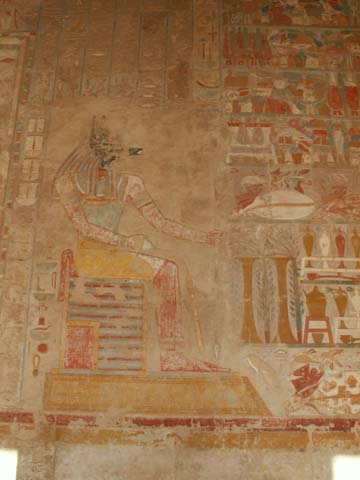
Anubis receiving offerings from Hatshepsut. Her portrait to the right of the table has been erased
Having received our instructions as to what to go and see Mina left us to take the TGV down the walkway to the temple. A speedy little number, our train was powered by forklift.
At ground level we had been told to look at the pictures showing the transportation of the great obelisk down the Nile.
Going up the first ramp you start to realise that the temple is in fact very deep and doesn't go straight up as it appears to do from a distance.
On the first level we visited the chapel of Anubis the Jackal headed god of mummification and I got hassled by one of the old stewards who insisted on telling me things that I already knew and then had the temerity to demand money for his efforts.
He should take up washing car windscreens at traffic lights instead.
There is a small temple dedicated to the goddess Hathor on the middle level.
Hathor is depicted with the ears of a cow and this was her animal form.
This explained why we saw a picture of Hatshepsut drinking milk from a cow wearing the symbols of Hathor (to make sure you realise that this is in fact a goddess not an everyday Jersey).
The outer buildings are constructed but the actual sanctuary of the temple on the upper level are carved into the rock. The architect's idea was that the sanctuary led in to one side of the mountain and the entrance to the actual tomb led under the temple from the other side of the mountain and the Valley of the Kings.
Along the front of the terrace stand statues of the pharaoh complete with her false beard.
The Valley of the Kings
All of our group being in a good physical condition, the decision had been taken that rather than take the bus round to the valley we would walk up and over the hill.
It was quite a climb and the sun was starting to get quite warm but the views were stunning as you arrive in the first instance right above Hatshepsut's temple and then later on looking down into the Valley of the Kings.
We met people coming the other way but I definitely have the impression that we had the slightly easier descent, if the harder ascent. On loose rocks it is difficult to fall up a steep slope.
In order that we would have our tickets ready, Mina had taken the bus round to the ticket office on the far side and then crossed the hill on foot to rejoin us.
Our first view of the tombs is as I remembered, a cluster of underground entrances connected by paths. If you are expecting to see great memorials to the dead you will be disappointed.
The pharaohs had come to realise that building pyramids was all very well but they acted as a large sign - treasure buried here ! Thus they came to this valley out in the desert a long way from likely prospectors for ill gotten gains.
One of the problems that they started to face was the fact that there was no map. The tombs were secret and thus it became a little haphazard as to whether or not corridors connected through to other tombs.
The best tomb - that of Seti I (Father of Ramses II) is closed to the public, but Mina explained that when Ramses III started his tomb his architects found that had cut through into to it.
Our tickets allowed us to visit three tombs out of the average of ten that are open at any one time. The most celebrated of the tombs here is of course that of Tutankhamun and you pay through the nose to go and see it. Other tombs are more interesting and besides, all the treasure is in the museum at Cairo.
You are not allowed to use a video camera on site and are not allowed to take photos in the tombs. Outside there is not a great deal to photograph apart from the rocky scenery.
Following the pathways JJ and I decided to head immediately to the tomb of his now alter ego Thutmose III.
You climb a long metal staircase to reach the entrance up on the cliff face before descending down into the tomb. A large pit designed to deter robbers used to contain the skeletons of undeterred robbers but a small bridge has been built for tourists.
It was very warm inside but the colours and designs in a sort of stick figure form are superb and unique to this tomb. A further descent leads into the burial chamber itself. Here you can see the sarcophagus and for a small sum of baksheesh the steward will light up the interior with his torch (secret ! secret! This is special - aye surely for everyone).
A cache of nine mummies was found near Hatshepsut's temple and Thutmose III was amongst them. He was considered to have been a great warrior and with his short stature has even been compared with Napoleon. His mummy is now in the museum at Cairo.
Ramses III's tomb is quite different to that of the Thutmose III with superb paintings showing the various rituals and the gods that the pharaoh could expect to meet in the hereafter.
At the end of the chambers a small gate prevents you from going any further and it is here that you get a feeling for the interconnection between some of the tombs. After all Tutankhamun's tomb lay undiscovered in part because Ramses VI put his own tomb right over the top of it.
The final tomb of our three was that of Ramses IV which contains his enormous red granite sarcophagus with the figure of the sky goddess Nut over the top swallowing the sun each evening and giving it rebirth every morning. The chamber is important in that this is the only representation of the Book of Nut in the valley.
The Colossi of Memnon
Having visited the Valley of the Kings we made a short visit to one of the Alabaster Centres which carves the various statuette etc for tourists. Mina confirmed their quality but warned us to be careful of the pricing. Like almost everywhere else in Egypt you barter for goods.
We were approached by a young man who identified himself as an Ali, and who spoke better English than French. I wanted a small statue of Horus and JJ was after a figure of Anubis.
We found what we were after and began talking money. Ali wanted 100 Euros for the two small figures, but said he would be nice and settle for 60. I asked JJ for his opinion and he reckoned that 20 for his and 15 for mine was more than enough.
35 I said. Ali smiled: my friend you are joking ?
No, if I was joking I would have said - a man walks into a bar with a horse... Oh you are funny man sir !
In the end we settled at 40 Euros.
Transactions done and freebies of scarabs (they bring good luck because they are related with the sun god) we set off back to the boat via the Luxor Bridge.
On our way we had the chance for a quick photo shoot at the Colossi of Memnon.
These two huge figures represent Amenhotep III seated on his throne and originally acted as guards to his mortuary temple which was the largest built in the area. Amenhotep III alas built the temple too close to the Nile and over the centuries the annual inundation slowly washed it all away leaving just these two symbols of a former glory.
The Greek name comes from a hero of the Trojan War and king of Ethiopia: Memnon. It would appear the Greeks found a similarity between the two names.
In antiquity a fissure in the rocks (now repaired) caused the monuments to sing in the morning breeze.
Back on board our boat it was time to pass a lazy afternoon as we sailed south towards Edfu.

 Page 4
See also