
The Citadelle and Battlefield
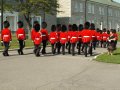
Redcoats, bearskins and French
29 August 2007
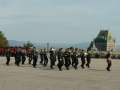
For our first morning actually together, the pair of us decided to go and see the changing of the guard at the citadelle.
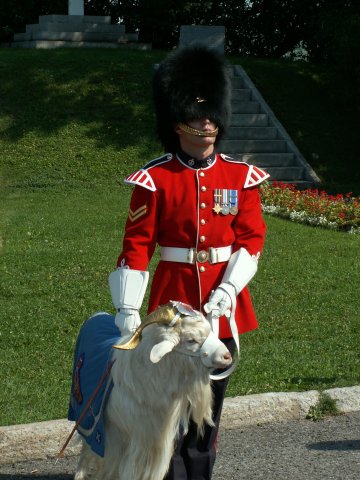
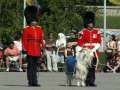
Batisse the Regimental Mascot
When Québec fell to the English in 1759 there wasn't really a citadelle to speak of, just a long stone redoubt and a powder house facing towards the Plains of Abraham. Sixteen years later the British found themselves at the receiving end of an attack by the Americans and further defences were thrown up, but it would only be after the Napoleonic wars, in 1820 that the British would finally build the citadelle which sits on the Cap Diamant today.
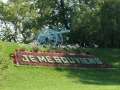
Québec's citadelle serves as a garrison to the Royal 22è Regiment who trace their existence back to the First World War.
In the early stages of the war it had been felt necessary to create a French Canadian Regiment for those Francophones who wished to fight but had no desire to be submerged in English speaking units.
The Vandoos, as they became known, served with great valour throughout the war fighting on the Somme, Ieper, Arras and Cambrai. On returning home the regiment was disbanded but in 1920 the regiment was re-created as part of Canada's permanent forces.
In 1921 King George V added Royal to their title and Maréchal Foch the allies former supreme commander became the first Honorary Colonel.
They are the second oldest French speaking regiment in the Canadian forces.
The Relève de la garde
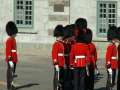
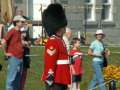
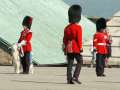
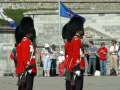
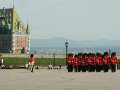
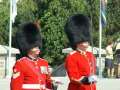
I am not certain which of us was more bemused, Jean-Jacques or myself, on seeing these soldiers forming up in their red tunics and bearskins and then hearing all the orders being bellowed in French.
JJ was bemused by the idea of having anything as British as a Changing of the Guard done in any other language than English.
It is all very British in structure with lots of stamping of feet and tick tock timing. The New Guard forms up and is marched onto the parade ground where it is joined by the Regimental Mascot: Batisse the goat, and his handler. The orderly officer arrives and carries out an inspection before requiring the Old Guard to march on for the handing over of duties.
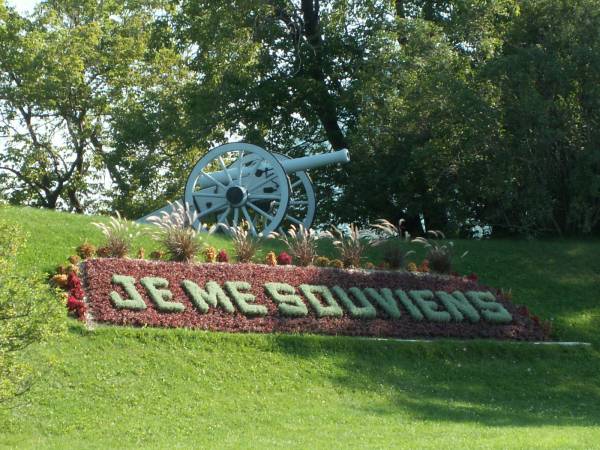
Yet, as you listen in as the soldiers - align bien, and the band plays Marche Lorraine as the Garde Montante take up their duties you realise that whilst they may have taken on parts of another culture these soldiers haven't forgotten that their ancestors were the original founders of Canada.
Je me souviens - the motto of Québec - I remember.
The Plains of Abraham 1759
Stretching out from the citadelle towards the west is the huge battlefield park containing a number of plaques showing where the various units of the two opposing armies fought on 13 September 1759. There is also a monument situated where General Wolfe died and and a plaque marking where the Marquis de Montcalm was fatally injured.
What there isn't, as far as I could see, was any form of overlay on one of the maps to mark all this graphically. For a good idea of that you need to go to the Musée du Fort in the town.
In 1534 the Frenchman Jacques Cartier sailed up the Saint-Laurent River to the Indian village of Stadacona. On landing he declared that all of the new found territory now belonged to the King of France. Needless to say, he didn't consult with the previous occupiers of the territory.
The local word for a village was Kanata and Cartier began using Canada on maps to mean not just the village but the surrounding area as well.
In 1608 Samuel de Champlain arrived with settlers and founded the town of Québec (a derivative of kepek meaning a Straight or narrows) near the village of Stadacona. The town thus became the first in Canada to have been founded as a colony as opposed to a trading post.
As French explorers and colonists spread, Nouvelle France came into existence to the north of New England.
In Europe 1759 was the time of the Seven Years war, with Britain and France on opposing sides. The moment seemed to be ripe for the British/American colonists to make an attempt on their old world adversary's possessions.
Although the British had some success, the stunning position of Québec, left the French commander: Montcalm reasonably confident that he could hold out until reinforcements arrived.
A certain Captain James Cook sounded out the waterways for a British flotilla and General James Wolfe arrived leading a small army, of about 7 000 regular troops, which he initially disembarked slightly down river from Québec opposite the Montmorency falls.
Facing him the French had about 12 000 soldiers and militiamen strung out between the town and Montmorency. Montcalm used his position to great effect, beating off all attempts by the British to get a toehold on the northern shore.
In a nut shell, Wolfe became fed up with Montcalm's refusal to do battle and his own inability to get across the river. Time was also pressing and Wolfe decided that either he acted in September or it would be too late.
He thus decided to take the gamble in trying to land his men between Québec and the French reserves further upstream. This would mean having to climb the steep sides of the cliff to get a footing on the plateau in front of the town.
Luck was with him and the first Scottish soldiers landed came across French sentries waiting on supply boats. When challenged the Scots replied in French and the surprise was complete.
By sunrise Wolfe had his small army on the Plains of Abraham with just one cannon that they had managed to haul up the cliff. In the French camp Montcalm heard the news and rushed from Montmorency to the town.
Most of his available soldiers were inexperienced militiamen and he could have waited for the support troops to arrive from behind Wolfe, but for whatever reason he felt that if he didn't push Wolfe off the summit, and quickly, all would be lost.
The French militia advanced supported by regular soldiers, but they tended to fire at will and from too far away. The British were so stretched that for the first time in history they were forced to form a thin red line of just two ranks instead of the customary three.
The redcoats kept their nerve and held their fire, and held their fire, until the French were a matter of 20 metres away. At that moment the front rank fired a lethal volley into the French followed moments later by a second volley from the rear rank. The battle was over - the French attack collapsed and the soldiers retreated to the town. It had taken under an hour.
Famously, both Wolfe and Montcalm had been fatally wounded, with Wolfe dying on the field and Montcalm the following day.
Québec changed hands and before the French could win it back again the war in Europe came to an end and France was forced to cede her possessions to the British.
During the American War of Independence an American Army under Benedict Arnold invaded Canada with the intention of wooing the French-Canadians to side with their revolution. The Frenchmen however decided that they had a better chance of retaining their heritage with the British (Who by lack of anglophone numbers had been forced to make certain concessions to their newly conquered people) and British Troops and Canadian Militia held out against the Americans.
George Washington eventually gave up on the idea of taking Canada as he felt that even if he could take Québec he would never be able to hold it.


See also