
Across the tropic of Capricorn




Dawn over the desert
23 November 2006
Bip Bip - oh goody at is 0200 hours and time to get up.
Clutching our packed lunches and pillows we piled into our mini bus at 0300 and set off to join the convoy which gathers near the edge of Aswan each morning.
I can't quite understand why they do this because the moment we actually started on our way it was every man for himself. Mina assured me that the military were never far away from, but I remain doubtful. There are places in the desert where you could see the black line of the road for kilometres and we were the only vehicle on it.
JJ made himself comfortable and fell asleep whilst I dozed a bit and watched the desert drift by.
I have travelled across Australia by bus and at least there you see a cow every few hundred kilometres. In the Libyan desert which forms part of the great Sahara there was very little - not a gum tree in sight.
The road from Aswan to Abu Simbel is excellent and would need to be for the 300 kilometre drive. The desert here is a lot rockier than you might think with outcrops scattered here and there. At other times though it was as flat as a Picardie beet field.
Just before our arrival in Abu Simbel the sun came up over the sand dunes: a stunning red ball. Wake up! Jean-Jacques.
On our very first day Mina mentioned that whilst the pyramids are impressive he felt that the construction of Abu Simbel by Ramses II was a greater achievement.
No photos of any sort are allowed inside the temples - you risk having your camera/video confiscated
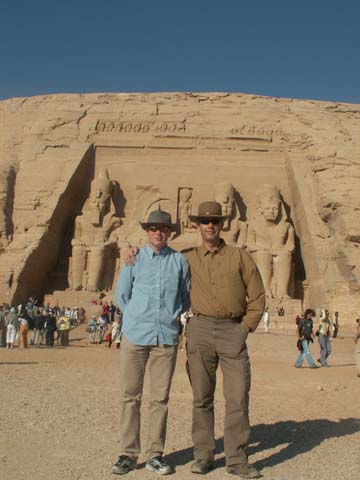
JJ and I at Abu Simbel
There are two marvels about the temple complex at Abu Simbel. One, is that in order to save it from Lake Nasser it had to be carved into blocks and moved a few hundred metres to get it above the flood level.
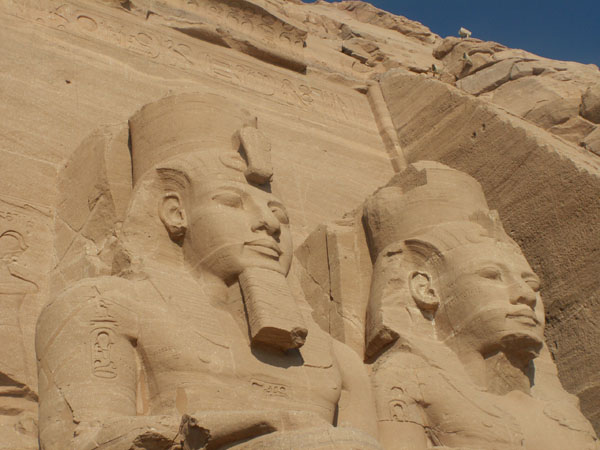
The second is the easily overlooked fact that these temples are not built but carved onto and then into the mountain side. The traces of lines that you can see across the façade were caused during the removal process.
Ramses II wanted his temple built in a particular way so that the central chapel would be lit by the rays of the sun - on his birthday. His engineers therefore had not only to carve into a mountain side but also on a very particular axis.
When the temples were moved it was decided to leave the parts of the head that had fallen during an earthquake where they were rather than put them back into place.
Mina explained things to us about the two temples asking questions to make sure that we had learnt a little along the way.
Ever since the alabaster works he had been carrying a small sack of mini scarabs and these were handed out as rewards for getting the answers right.
JJ will push the point that he got one more than I did because he knew who he was during one of Mina's talks about the gods. This I consider as tantamount to cheating - teacher's pet !
The main temple is not dedicated to any god but to Ramses II himself as a living god. The four 20 metre statues which adorn the façade are of the pharaoh with just a small sculpture of the god Re-Harakhti over the doorway.
Between Ramses's feet and at his side are statues of some of his children (he had about a hundred) his mother and three versions of his favourite and adored wife: Nefertari.
The ridge of the temple is lined by 22 baboons whom it was believed aided the sun to rise each day with their cries as dawn breaks.
The temple is situated in what was Nubia and not Egypt as it was Ramses's intention to show off his might as well as further the interests of the Egyptian gods in the region.
The work began in 1284 BC and lasted for twenty years or so.
Looking at the size of the outer carvings it is hard to believe that in the passage of time it was all covered in sand and was lost to all but the locals until 1813 AD.
Entering the temple you will pass by the keeper of the enormous ankh door key who reminds people throughout the day - No photos. I was disappointed when he only warned an Englishman to stop taking photos as opposed to jumping up and down on his camera.
There are signs around everywhere asking you not to take photos - so don't. The colours on the walls will only last for a while longer and if everybody used flash there would soon be nothing left at all.
Inside you are greeted by eight statues of Ramses in the Osiris position - arms crossed, feet together - you are dead.
The walls are covered in pictures showing Ramses supposed triumph over the Hittites (Syrians) at Kadesh. In fact neither side won but the battle did result in the first ever recorded peace treaty which can be seen outside to the left of the four colossal statues.
Ramses may not in truth have won the battle but he did win a bride as part of the peace process - the daughter of the king of the Hittites.
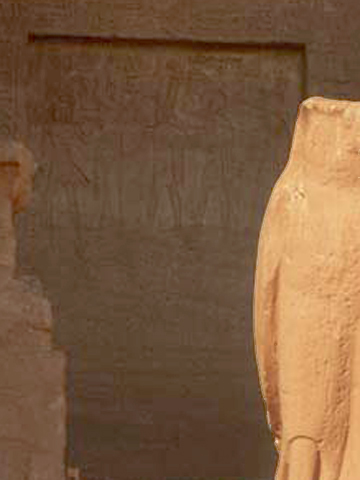
The marriage contract between Ramses II and the Hittite princess
Mina mentioned that when you look at Ramses in his chariot launching arrows for all he is worth you can see that his horse appears to have eight legs. So do other horses however, so it would not appear to be a sculpting error but perhaps an attempt to indicate the movement of the horse (Motion blur in stone).
It can be hot and crowded inside the temple and I think JJ and I found it difficult to take in all that we were looking at with the press of the crowd.
Eventually you come to the inner sanctum, the naos, where there are four statues: Ptah, Amun-Re, Ramses II and Re-Harakhti. In this way Ramses associated himself with three of the important gods of the New Empire
On Ramses birthday, 20 February the sun would light up all but Ptah who as a god of the underworld kept tanning to a minimum. Since the displacement of the temple the sun arrives a day late
Back out into the sunlight we moved to the smaller temple dedicated to Ramses great love, Nefertari and the goddess Hathor.
Nefertari's importance can be seen by the fact that she is carved the same size as her husband, unheard of anywhere else. Ramses wrote that Nefertari was the reason that the sun rose each day.
Inside the temple the carvings are more peaceful than Ramses's own temple with scenes depicting offerings to the gods and hunting. There is however still just a wee bit of smiting in places.
The columns in the main hall are decorated in Hathor fashion and many of the portraits of Nefertari show her in a Hathor style crown with a sun disk and cow horns.
It had been a long morning and it still wasn't 0900 hours but Jean-Jacques agreed that the trip had been worth the effort.
Coming out of the temple complex I wanted to buy a book with some good photos. One of the merchants started talking us through all of his books and one was particularly impressive but so was the price. I was very much in two minds. The photos were stunning but would we actually look at it again. If not, it wasn't worth paying the asking price.
The asking price was 35 Euros (he should have been wearing a mask) and in the end I decided that it wasn't worth bothering. I tried explaining this and even put the book back on the shelf and left the shop, but he came running after me telling me how good the book was and how rubbish the others were - which was true on comparing the quality of the photos.
I told him I wasn't paying more than 15 Euros for something that would hardly be looked at again - and we agreed at 18 !
Next stop was a hat for Peter. He wanted a Fez but that is another country so he was going to have to make do with a Nubian woolly hat. We chose our milliner and JJ chose the colours. All we had to do was agree on the price.
No matter what language you want to use - they can rob you blind in it. As always you had to be careful with handing over money. My advice would be make sure they have any change necessary before you part with notes. They know that you are being hurried back to your bus for the return convoy and run about trying to find somebody with the change hoping that you will tell them to forget it. Not me - I want every centime they owe me.
On the way back to Aswan we crossed the Tropic of Capricorn and all around us was water. I have seen the odd mirage here and there but this was amazing, you could have mistaken it for Lake Nasser there seemed to be so much of it.
I thought of trying some photos along the road, but with the jolting of the vehicle everything would have just been blurred.
We arrived back on board our boat just after midday with just enough time to use the toilet, wash and brush up, and set out again for a trip round Elephantine Island in a sailing boat - a felucca.
Our captain was 26 years old and had been saving like a mad thing to afford his own boat. With his crew of two they took us down the Nile alongside Kitchener's Island and back round Elephantine Island.
By now I was starting to have stomach problems and could probably have taken more photos than I did.
As you sail around, youngsters paddle out to hang on to the side of your boat and then sing songs in almost any language they are likely to meet.
Our crew also sang songs and danced as we rounded the headland before settling back to work and tacking their way back through the other feluccas and cruise ships.
We had the opportunity of buying some Nubian trinkets and JJ picked up a wooden cobra for a couple of Euros.
As soon as we were back on board our boat we set sail for Kom Ombo on our way back to Luxor. Diner was served and I realised that I was indeed unwell. Previous experiences have taught me that you let it run its course and just have to get as much rest as possible - and eat bananas !
JJ went ashore without me at Kom Ombo to visit the temple of the crocodile god Sobek. It was after sunset so the temple was floodlit. Looking back on it I shouldn't have talked him out of taking the camera because on the way back he saw a snake charmer with some live cobras and it was thus my fault that he didn't get any pictures.
That evening our crew threw an oriental evening and JJ had to buy himself a gallabeyya for the occasion. Somehow he managed not to get himself photographed - I will have to seek out photos from other members of our group.
They sounded as if they had a good time though JJ told me that despite it being a special meal, they still got rice.

 Page 8
See also