
Crécy-en-Ponthieu
The Battle of Crécy: 1346
The Battle of Crécy on 26 August 1346 was one of the major points during the Hundred Years War between England and France.
The war had started in 1340 as a direct consequence of English claims to parts of Normandy and France. Edward III of England started his campaign with a victory at Sluys (Now Holland) but his efforts to invade France from there met with failure.
In 1346 he tried again, but this time invading via Normandy. By August his army had reached the Somme and at Crécy he found himself opposed and outnumbered by Philip VI of France. Edward's army numbered about 12,000 men with his opponents more than treble that according to some sources. Regardless of figures, it is accepted that the English army was a lot smaller than the French.
Edward chose his position carefully on the slope of a small hill with plenty of natural obstacles on both his flanks. On the ridge and behind his army was a windmill which Edward used as his headquarters.

The view from the Edward's windmill
His orders for the day were that the army would fight on foot, and that it would be divided into three groups, with his sixteen year old, The Black Prince, in command of one of them. Trenches were dug in front of the army and caltrops laid to bring down the French cavalry. The English weapon which was to prove so decisive was the longbow used by Edward's Welsh archers and these he had placed on his flanks covering his infantry in the centre.
The first move made by Philip was to send his Genoese crossbow men forward in attempt to disrupt the English infantry before the French nobles on their horses put in their winning charge.
The crossbow however was no match for the longbow. With a greater range, the longbow had a firing rate of perhaps 10 or 12 arrows a minute in the hands of an expert to the 3 or 5 of the crossbow. The Genoese retired with heavy casualties and Philip sent in his cavalry. The French nobles were met by a wall of arrows which when added to the trenches and other traps and pitfalls laid by Edward's men completely broke down the charge. Several attempts were made to break the English line but all ended in failure.
By the end of the evening a wounded Philip VI ordered his army to retreat.
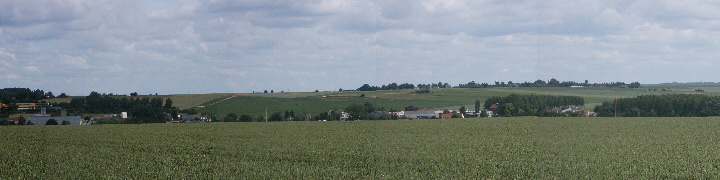
The view from the French lines
The windmill on the left of the horizon, Wadicourt church to the right
Edward continued his victorious march to Calais which after being besieged surrendered leaving northern France back in the hands of the English.
One of the legends of the battle is that the 80 year old King Jean of Bohemia had rallied to the French cause and insisted that he be allowed to strike at least one blow against the enemy - despite his being blind!
His retainers tied all their horses together and led him into battle. There he fell in combat but not before he had smitten a goodly few of the English.
The Black Prince was so impressed by the old king that he took the three feathers from the king's helmet and took up his motto : Ich dien
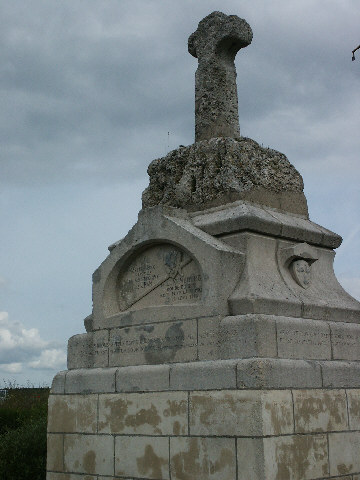
The Memorial to the King of Bohemia
Today, a cross stands on the road side near to the point where he fell. If you visit the Czech Military Cemetery at Souchez you will find a copy of the cross there, linking the centuries of comradeship between the two nations.
A monument in the town square also serves as a reminder to the valour of the King and all the French who died that day.
I would have a slight disagreement when the monument says that they were fighting for their land because in theory the area was part of England - so was it not the English that were dying in defence of their country? Much too complicated, and it took a hundred years to sort it out the first time.
See also
Czech Military Cemetery, Souchez